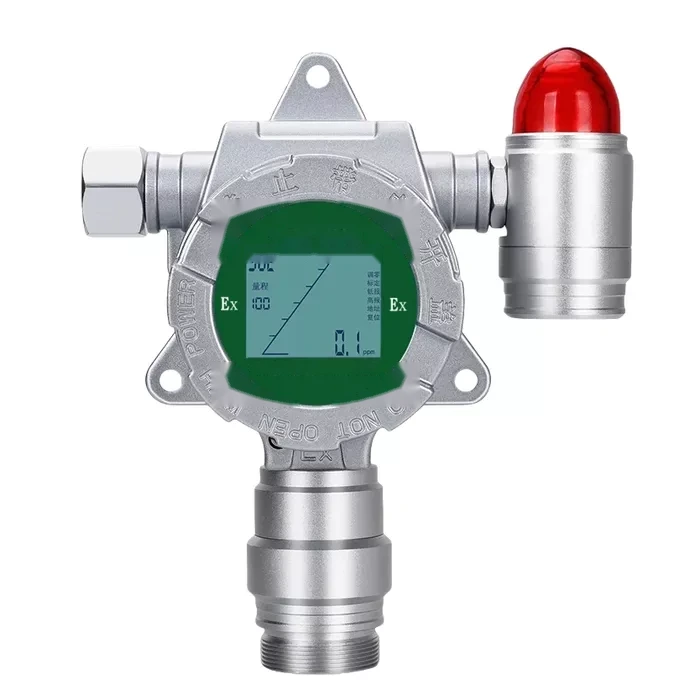
Fixed Gas Detector

Welcome to Shenzhen Huanqitong Technology Co., Ltd. β€” Professional Detection Instruments πŸ“ž Tel: 138-2330-8550 πŸ’¬ WhatsApp 13823308550 πŸ“§ Email: 1479246994@qq.com δΈ­ζ–‡
Professional Gas Detection & Process Concentration Analysis

HQT-1000 SeriesFixed Gas Detectors

2-in-1 to 7-in-1 configurable, 4-20mA / RS485 output, Ex d IIC T6 explosion-proof + IP66 protection. OEM / ODM customization for both finished units and sensor modules. 24/7 unattended continuous monitoring.

OEM/ODM Available Huanqitong HQT-1000 Series Fixed Gas Detector for combustible and toxic gas monitoring

Overview

Fixed gas detectors are installed at process units, tank farms, fence lines and utility tunnels where 24/7 continuous online monitoring is required. They measure combustible gas, toxic gas and oxygen concentrations in real time and transmit 4-20mA or RS485 / Modbus signals to a DCS, PLC or gas alarm controller for audible/visual alarms, fan activation and valve shutdown.

Any combination from 2-in-1 to 7-in-1 is available, with electrochemical, catalytic bead, PID and NDIR sensors selected per application. Measuring ranges and alarm thresholds are customizable.

Typical Specifications

Target Gases

Combustible (LEL), O2, CO, H2S, NH3, Cl2, SO2, NO2, VOC β€” 2-in-1 to 7-in-1 combinations.

Detection Principle

Catalytic bead / electrochemical / PID / NDIR, matched to the target gas.

Output Signal

4-20mA, RS485 / Modbus RTU, relay output; optional 4G / LoRa wireless.

Explosion & Protection

Ex d IIC T6 design, IP66 rated for outdoor and corrosive environments.

Power Supply

24 VDC standard, wide-voltage design available.

Installation & Selection Notes

Mounting height: heavier-than-air gases (H2S, SO2, Cl2, LPG) at 0.3–0.6 m above floor; lighter-than-air gases (methane, hydrogen, ammonia) 0.5–2 m above the leak source; oxygen detectors at about 1.5 m.

Point layout: place detectors by leak source distribution, ventilation and worker zones β€” typically one point every 15–20 m in process areas, covering valves, flanges and pump seals.

Recommended pairing: fixed detectors cover the area; pair with portable gas detectors for patrol checks, and manage the system through a gas alarm controller.

ModelGasTypical RangePrinciple
HQT-1000-CH4Methane / Combustible0-100%LELCatalytic bead
HQT-1000-H2SHydrogen sulfide0-100 ppmElectrochemical
HQT-1000-COCarbon monoxide0-1000 ppmElectrochemical
HQT-1000-O2Oxygen0-30%VOLElectrochemical
HQT-1000-NH3Ammonia0-100 ppmElectrochemical
HQT-1000-Cl2Chlorine0-20 ppmElectrochemical
HQT-1000-SO2Sulfur dioxide0-20 ppmElectrochemical
HQT-1000-VOCVOC0-200 ppmPID
HQT-1000-HFHydrogen fluoride0-10 ppmElectrochemical
HQT-1000-SO2F2Sulfuryl fluoride0-50 ppmElectrochemical
HQT-1000-4S4-in-1 LEL/O2/CO/H2Sβ€”Composite

FAQ

How often should fixed detectors be calibrated?
Every 6-12 months recommended, depending on conditions, gas type and environment; shorter for toxic or corrosive gases.
Which gas combinations are supported?
2-in-1 to 7-in-1 covering LEL, Oβ‚‚, CO, Hβ‚‚S, NH₃, Clβ‚‚, SOβ‚‚, NOβ‚‚, VOC etc., with catalytic bead, electrochemical, PID and NDIR sensors per application.
What output signals are available?
Standard 4-20mA and RS485 / Modbus RTU, optional relay and 4G / LoRa wireless, connecting to DCS, PLC or gas alarm controllers.
Can it be customized?
Yes. Range, alarm thresholds, housing material, output protocol and mounting are all OEM / ODM customizable.

Need a Selection Proposal & Quote?

Simply provide the target gases, ranges, number of points and output requirements.

Request a Quote